
Learn to look beyond the pattern. Origin, construction, condition, and the details of an auction lot all help you decide whether a rug belongs in your collection.
Start with the rug. Then study the record.
This guide introduces the questions to ask before you bid, whether you are choosing your first antique rug or adding to an established collection.
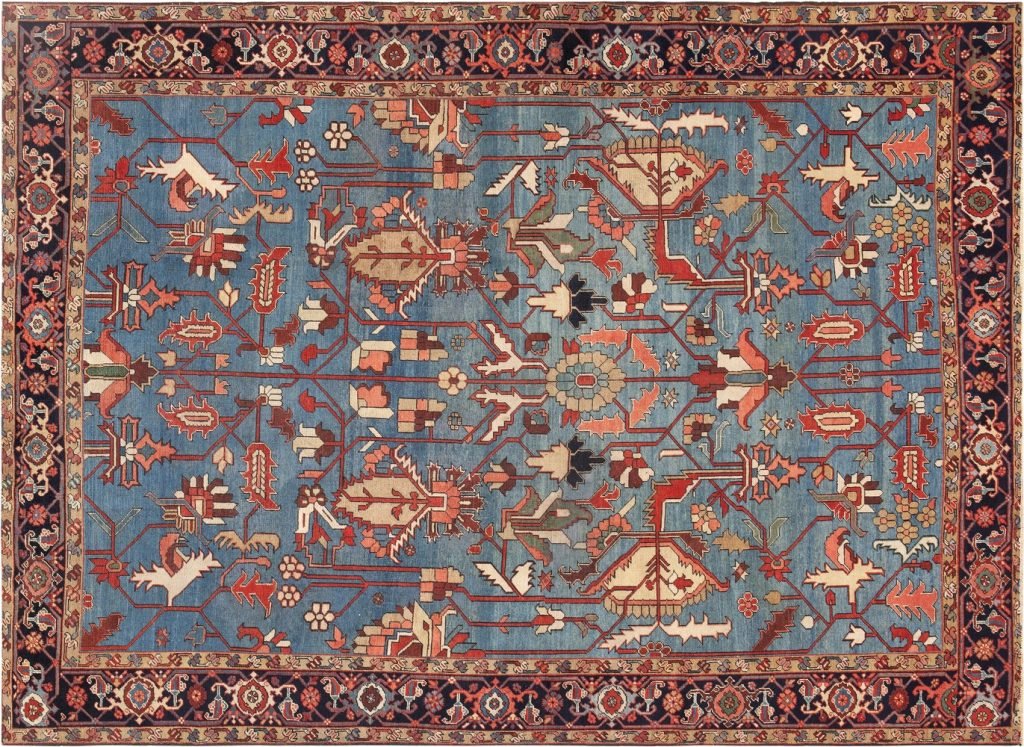
“Persian” refers to rugs made in Iran. “Antique” generally describes a rug at least 100 years old. These terms provide a starting point, but neither tells you everything about the object in front of you. A useful catalog description also identifies an attributed weaving origin, approximate date, materials, dimensions, and condition.
A regional name is a guide to further study, not a substitute for examining the rug. Read an attribution alongside the photographs and ask which features support it. Design alone should not be treated as proof of origin or age.
Begin with the whole design: the relationship between the field and borders, the balance of open space and ornament, and the way colors lead your eye across the rug. Then look more closely at the drawing. Does the design feel spacious or tightly organized? Is it built around a central medallion, or does a pattern repeat across the field?
Compare several examples rather than trying to memorize a single “correct” appearance. Your aim is to understand what you respond to and to develop questions for a specialist. A rug can be compelling for its drawing, palette, unusual proportions, or the character of its weaving.
The V&A’s Ardabil Carpet carries an inscription dating it to 1539–1540. Its elaborate medallion composition offers a useful reference for studying the ambition of historic Persian carpet design. A museum masterpiece is a point of learning, rather than a pricing comparison for an auction rug.
Study the front, reverse, edges, and ends. A full view shows the composition; detailed images can help you ask about wear, repairs, and construction. If an area is difficult to interpret, request an additional photograph and a written explanation before bidding.
Condition is a matter of suitability as well as appearance. Tell the auction team whether the rug is intended for a busy room, a quieter setting, or display. A condition description helps inform your decision, but it should be read together with the auction’s terms.
Request clarification of the pile and foundation materials when the description does not specify them. Ask which observations support the stated construction and attribution. Close photographs of the reverse may be helpful, but they do not replace handling and specialist examination.
A single measurement or feature should not become your entire buying decision. Consider the design, materials, condition, scale, and documentation together. If you can attend a viewing, bring your questions and take the time to see the rug as a complete object.
Read the complete lot entry, including any qualifications to the date or attribution. If provenance is supplied, ask what records accompany it. An ownership history, an earlier catalog reference, and an undocumented tradition are different kinds of information.
Use previous auction results as context. Before comparing two rugs, consider differences in dimensions, condition, materials, design, and the basis of the published price. A hammer price and a total including buyer’s premium are not directly interchangeable. Past results do not promise the outcome of a future sale.
Your bidding limit should account for more than the hammer price. Review the buyer’s premium, applicable taxes, payment charges, shipping, insurance, and any costs you expect after delivery. Obtain a shipping estimate before the auction if the cost will influence your limit.
Check the current auction terms and conditions for payment deadlines and the conditions of sale. Read them before bidding, even if you have purchased at auction elsewhere.
Write down a maximum bid that works within your total budget. The right purchase is one you understand and can comfortably complete.
Explore the catalog with a specific question in mind: a palette you enjoy, a size you need, or a design you want to understand. Save examples, compare their descriptions, and ask for guidance when a detail is unclear.
Learn about buying at Nazmiyal Auctions · Contact the auction team
Nazmiyal Collection: Persian Rugs
Victoria and Albert Museum: The Ardabil Carpet
Nazmiyal Auctions: Terms and Conditions
This introductory guide supports further research. For information about a particular lot, consult its catalog entry and contact the auction team.